Key Insights
Every AI agent acts through a non-human identity, and according to IBM's 29 July 2026 analysis of its Cost of a Data Breach findings, fewer than half of organizations are actively securing those identities. AI agent sprawl is the unmanaged growth of those agents, leaving no clear record of who owns each one, what it can reach, or when it should stop.
Agent creation is built into low-code builders, copilots and SaaS products, so an employee can stand one up with no ticket and no identity review. The agents are often useful. The risk is growth nobody tracks, such as agents still acting with live credentials after their creators move on.
This guide marks the line between sprawl and shadow AI, traces where unregistered agents come from and works through the controls that bring them back, from an agent register to scoped credentials, review dates and decommissioning.
What Is AI Agent Sprawl?
AI agent sprawl is the uncontrolled growth of agents across many teams and platforms, each with an unclear owner, unclear permissions and an unclear lifecycle. What makes an unowned agent consequential is that it acts with tools and data, not just answering.
Where AI Agents Come From
Agents arrive through channels that each keep their own admin console, several with creation switched on by default:
Low-Code Agent Builders: Every user can create and share agents, often without approval.
Copilots with Actions: Assistants call connectors that act with end-user or maker-provided credentials.
Developer Frameworks: Open-source agent frameworks connect models to tools through Model Context Protocol (MCP) servers and API keys held in environment variables.
SaaS Features Shipped On: Agent capability arrives already enabled in products bought for something else.
No single team sees across all four channels, and nobody keeps a running total of the agents they produce.
Why Agent Counts Grow Faster Than Oversight
Oversight lags because agent creation is self-service and registration is usually optional. In one illustrative case, a sales team builds a lead-routing agent, finance builds an invoice summarizer and engineering wires a coding assistant to a repository, none of it passing through a ticket.
Connections happen ad hoc through OAuth consent screens, connector setup and MCP configuration files, so credentials get issued without an identity review. A large population of registered agents with named owners carries less risk than a handful nobody can account for.
How Is AI Agent Sprawl Different from Shadow AI?
The difference is that shadow AI is a usage question while agent sprawl is an identity question. Shadow AI is unsanctioned AI that people use, a form of shadow IT sitting outside an organization's approved systems, which makes it mostly about data handling. Sprawl takes in sanctioned agents too, because an approved agent on an approved platform still holds a service principal, an OAuth grant or an API key, and those credentials keep working after the project ends unless someone retires them.
Why Does AI Agent Sprawl Create Security Risk?
Sprawl creates risk because every agent is a non-human identity, and unmanaged identities collect access that nobody reviews. An unreviewed agent identity accumulates that access and exposure in distinct ways:
Orphaned Agents with Live Credentials: The Open Worldwide Application Security Project (OWASP) describes orphaned non-human identities as those still active after their owner departs, with nobody left to notice when one drifts beyond its authorized scope, which OWASP's 2026 agentic list covers as rogue agents.
Over-Permissioned Access: Broad mail, file or SaaS scopes granted for convenience fall under the same list's identity and privilege abuse entry.
Chained Agents and Tools: One spoofed message or faulty agent can propagate across every agent and tool connected to it.
Actions with No Audit Trail: An agent acting through a shared service account or a delegated token looks like that person in the logs, and the joint agentic AI guide from the Cybersecurity and Infrastructure Security Agency (CISA) names "obscure event records" as an agentic risk.
Data Exposure Through Prompts and Outputs: An agent with mailbox read access can surface sensitive contents in its outputs when authorization checks fail.
Ownership, scope, logging and revocation answer these in turn, which is the work of agentic identity security.
What Are the Signs of AI Agent Sprawl?
The clearest sign is an agent or credential that nobody can explain:
No Nameable Owner: Nobody can say who built the agent or why its service principal exists.
Discovery by Accident: Agents surface only during audits, outages or incident response.
Duplicate Agents: Several teams run agents doing the same job against the same data.
Forgotten OAuth Grants: Consent records nobody remembers approving.
Any one of them means an agent is acting with access no current owner can account for.
How Do You Find the Agents You Already Have?
Teams find agents that hold credentials by checking where an agent must register to act, from the identity provider and consent records to platform consoles, SaaS logs and code.
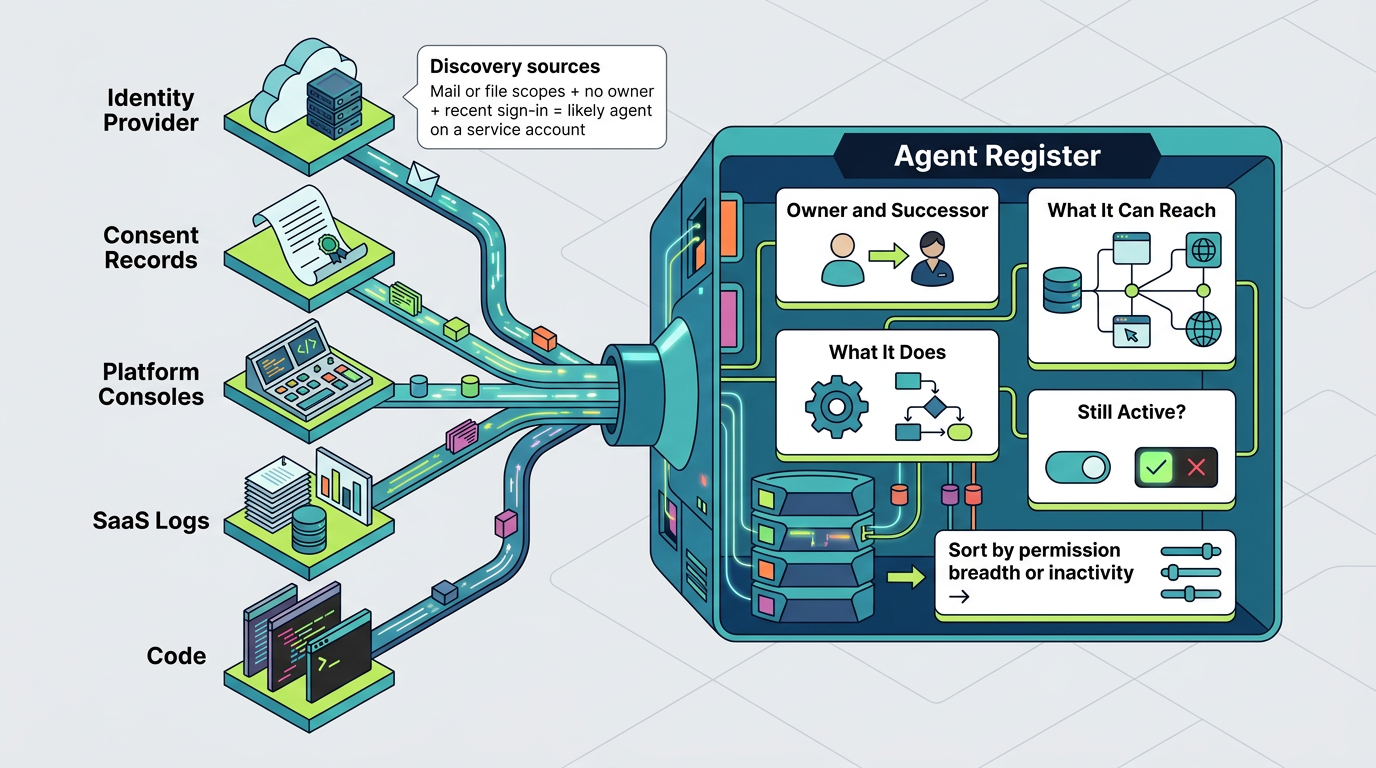
Check Identity, Platform and Code Sources
The identity provider comes first, because every agent that calls an API needs an identity there. Its list of enterprise applications shows each app's service principal with its consented permissions, and a principal with mail or file scopes, no owner and recent sign-in activity is likely an agent on a service account.
Platform consoles and code catch what identity records miss. Productivity suites list the agents built in their low-code builders, SaaS admin logs show agent activity, and dependency manifests such as requirements.txt and package.json name agent framework packages while secret scanners flag hard-coded keys.
Build an Agent Register
The findings go into one agent register, where each entry answers who owns the agent and who succeeds that owner, what it does, what it can reach and whether it is still active. Sorted by permission breadth, it shows a security architect where to look first, and sorted by inactivity, it shows an identity owner what to retire. Abnormal's AI Governance is designed to discover approved and shadow AI tools and attribute ownership, which supports broader AI governance programs.
How Do You Stop AI Agent Sprawl?
Teams can manage sprawl through identity controls that govern agents without banning them, the core of AI agent security.
Assign an Owner to Every Agent
Every agent needs a named owner and a named successor recorded at registration, because otherwise you'll discover the gap the day the owner leaves. Security sets policy, the identity team holds credentials, platform owners run the consoles, and a business sponsor answers for the agent's purpose. Admins can usually reassign low-code agents from the platform's admin center, and the successor can confirm any connection still running under the departed maker's credentials.
Scope Permissions to the Task
An agent holds only the access its task needs, for only as long as the task runs. The same CISA guide advises teams to "Limit entitlements to the exact resources, operations and timeframes needed," and favors short-lived credentials that expire when the job ends. An agent acting for a user should run in that user's context with the minimum privileges necessary, and tenant-wide mail or file read should require a documented exception.
Set a Lifecycle with Review and Expiry
Every agent carries an expiry date and a review schedule from day one. Reviewing active accounts, including service accounts, at least quarterly is a common baseline, and the National Institute of Standards and Technology (NIST) generative AI profile calls for protocols to deactivate generative AI systems when necessary. A change in scope, such as a new data source or a new tool, triggers re-approval rather than waiting for the next review.
Require Registration Before Deployment
Registration gates credentials. Employees build and test freely, but an agent gets production access only once it has a register entry, the form NIST's own guidance takes when it asks organizations to enumerate generative AI systems into their inventory. The identity provider's admin consent workflow is the natural enforcement point, routing requests to reviewers who can make a register entry a condition of approval.
Revoke and Decommission Ownerless Agents
Revoke an ownerless agent first, then decommission it. An identity engineer disables the service principal's sign-in, removes its delegated grants and rotates or deletes its secrets and certificates, though access tokens already issued stay valid until they expire. Teams set their own revocation target, such as one business day after a departure, and keep watching the agent's API and sign-in activity until the last issued token lapses.
How Do You Know Sprawl Is Under Control?
Sprawl is under control when these measures improve and then hold steady, each one tracking a single identity control:
Owner Coverage: The share of registered agents with a named owner and successor.
Permission Hygiene: Agents holding unused or tenant-wide scopes.
Time to Revoke: Elapsed time from an owner's departure to revocation, against the team's own target.
Registration Before Launch: The share of new agents registered before they first sign in.
Read monthly, they show whether new agents arrive faster than the register absorbs them.
Owned and Tracked Agents Stay Useful
Agents with a named owner, a defined scope and an expiry date stay manageable as they multiply, because each can be explained and switched off. Rising owner coverage and a shrinking time to revoke are the evidence.
Abnormal's AI Security suite includes AI Governance, which can help teams find approved and shadow AI tools and attribute ownership, alongside AI Agent Security, currently in private preview. Explore AI Governance to see how it builds that picture from signals an organization already collects.
Frequently Asked Questions
Is AI agent sprawl the same as shadow AI?
Shadow AI is unsanctioned AI use, such as an employee pasting data into an unapproved chatbot. AI agent sprawl includes those tools and also approved agents holding service principals, OAuth grants or API keys that keep acting after their purpose ends. That makes sprawl an identity problem as well as a usage problem.
Who owns an AI agent after its creator leaves?
The named successor recorded at registration should own it. Without one, platform behavior varies. Some tools let admins reassign ownership, some move sponsorship to a manager, and flows tied to a departed user can fail.
What permissions should an AI agent have?
An agent should hold the minimum access its task needs, limited to specific resources, operations and timeframes, ideally through credentials that expire with the job. Tenant-wide mail or file access should require a documented exception and a shorter review interval.
Should companies stop employees from building agents?
Agents built by employees often solve real problems quickly, and the risk comes from untracked growth. Organizations can let people build and test freely in a sandbox, while requiring registration, an owner and scoped credentials before an agent gets production access.
How often should AI agents be reviewed?
Review agents on a fixed schedule and whenever their scope changes. A quarterly review suits most agents. Agents with broad permissions or access to sensitive data merit more frequent review, and disable any agent past its expiry date.