Key Insights
Verizon's 2026 Data Breach Investigations Report (DBIR) found the average company had more than 15% of users with unauthorized AI extensions installed in their browsers, one route AI tools take into business systems without review. Shadow agents are AI agents that employees build or deploy without security or IT approval and that act on business systems with their own credentials.
Shadow agents keep reading mailboxes, moving files or calling APIs on a schedule. Nothing about them looks unusual, because their access arrives as an OAuth grant, an API key or a service account.
This guide compares shadow agents with shadow AI and shows where they come from and the risks they create. It then covers how security teams can discover them and bring each one under governance without pushing agent use further out of sight.
What Makes an AI Agent a Shadow Agent
An AI agent becomes a shadow agent when it runs multi-step tasks without a person approving each step and holds standing access to mail, file storage or customer records that nobody in security or IT reviewed. The software alone doesn't decide that status, since the same agent template can run under a registered, logged-in identity in one department and as an unreviewed side project in another.
How Shadow Agents Differ from Shadow IT and Shadow AI
Shadow IT puts data in unapproved apps, shadow AI tools answer a person's questions, and shadow agents act with delegated authority. The main risk moves from what someone pastes into a prompt to what an unattended process can do with its permissions, and each term calls for different controls:
Dimension | Shadow IT | Shadow AI | Shadow Agents |
|---|---|---|---|
What it is | Unapproved app or service | Unapproved AI tool | Unapproved autonomous agent |
What it does | Stores or processes data | Answers a person's prompts | Plans and acts across systems |
Identity used | User account | User account, often personal | OAuth grants, API keys, service accounts |
Main risk | Data outside approved systems | Sensitive data in prompts | Unreviewed actions with standing access |
Visibility | Network and spend records | Browser and network traffic | Identity, API and agent platform logs |
Shadow agents tend to surface in identity and agent platform logs, where an unfamiliar OAuth grant or API key stands out, rather than in spend records. Agent builders and identity platforms are the best place to start looking.
Where Shadow Agents Come From
Shadow agents grow out of tools employees already use: no-code agent builders, browser and desktop assistants, and AI features inside SaaS applications. Agent builders inside productivity suites and chat platforms let employees connect agents to email, shared drives and SaaS connectors faster than an integration review can run, and admin visibility varies by platform, edition and tenant settings.
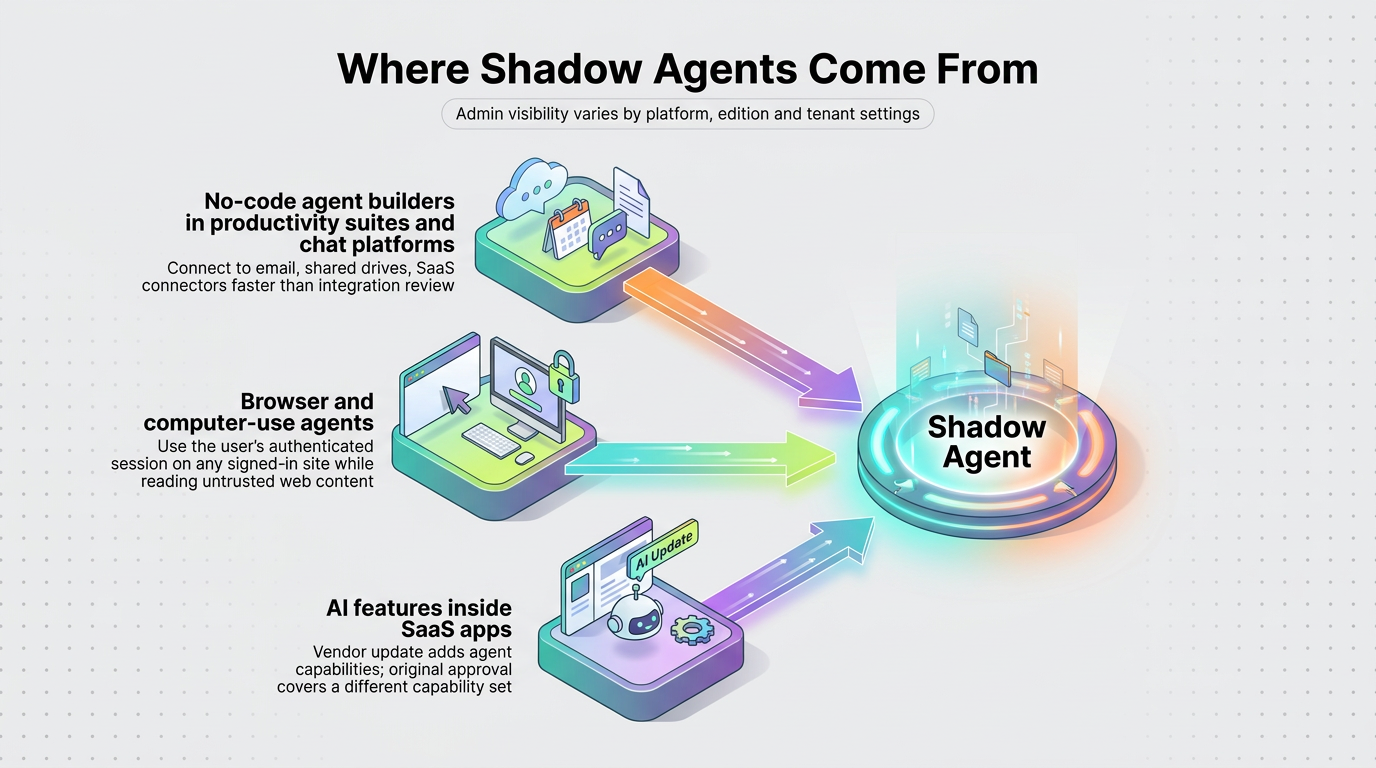
Browser and computer-use agents work through the user's own authenticated session, acting on any site where the user is signed in while reading untrusted web content. A vendor update can add agent capabilities to an approved SaaS application, and the original approval then covers a different capability set from the one now running.
Why Shadow Agents Are Hard to See and Govern
Shadow agents are hard to see because their actions are recorded under identities that already look legitimate, and no inventory ties those identities back to an agent. An agent often runs on its builder's OAuth grant or a shared service account, which logs its actions under a human name or a generic machine identity.
The Open Worldwide Application Security Project (OWASP) Non-Human Identities Top 10 (2025) lists a related problem, human use of non-human identities. Shared identities make human and automated activity hard to tell apart.
Verizon's 2026 DBIR advises paying special attention to service and machine accounts, which it expects agentic AI to rely on, and that periodic access reviews can overlook. Abnormal's AI Governance, generally available, is designed to discover sanctioned and shadow AI tools and agents and attribute an owner to each one.
Risks Shadow Agents Create for Security and Compliance
Each risk traces to autonomy, since a shadow agent holds access nobody reviewed, moves data across systems and takes actions with no person approving each step. Unreviewed access, data movement and unapproved actions turn a configuration mistake or hidden instruction into an incident.
Standing Credentials and Unreviewed Data Movement
A shadow agent's token keeps working after its builder changes roles, the Improper Offboarding risk that the OWASP NHI Top 10 ranks first, alongside Overprivileged NHI and Long-Lived Secrets. An agent connector that requests read-write access when its task only needs read access to one folder is an overprivileged identity in that sense.
Orphaned tokens also move data, and an agent copying records into an unapproved AI service can take personal data outside the processor authorization, records of processing and security duties in the General Data Protection Regulation (GDPR) Articles 28, 30 and 32. For high-risk systems, EU AI Act Article 26 adds deployer duties for human oversight and log retention. In an audit, an incomplete inventory leaves the organization unable to show which agent processed the data, under whose authority and with what logs.
Actions Nobody Approves
A shadow agent can take an action nobody approved while using fully legitimate access. For example, an accounts payable builder might connect an agent to the team mailbox to summarize vendor emails and draft replies. If a message that reads like a routine vendor note hides instructions to send the payment ledger to an outside address, the ledger can leave the organization through an authenticated mailbox without a human reading the reply.
The example combines prompt injection with excessive agency in AI agents. Instructions and data reach the agent through the same channel, which lets the model treat the hidden text as a task, and the agent holds enough permission to carry it out. No current defense fully stops prompt injection, so limiting the agent's permissions is the place to act: a mail agent without permission to send outside the organization could not have leaked the ledger even if the hidden instruction succeeded.
Why Banning AI Agents Backfires
A ban on AI agents can move agent use onto personal devices and unapproved routes where the security team cannot see it. The NCSC blog The hidden risks of shadow AI says that where policies fall short of business needs, organizations are likely to keep seeing employees adopt new AI services before they have had time to assess them.
Employees who expect a ban or a reprimand also have every reason to keep their tools quiet. Unmet needs and a penalty for disclosure are the conditions in which unsanctioned agents outpace traditional defenses.
How to Discover Shadow Agents in Your Environment
Discovery works best when identity, credential, traffic and connector evidence are read together. Agents built on cloud connectors need a grant before they touch mail or files, so third-party OAuth consents are the first place to look. Reviewers should flag unverified publishers, single-user grants and scopes that let an app send mail, write files or hold offline access.
Credential scanning of code repositories, automation platforms and secrets stores finds agents that never passed a consent screen, and every non-human identity found should be matched to an owner. An identity with no owner, no human logins and steady API activity is a strong candidate for an unregistered agent, especially when it calls at fixed intervals, works outside business hours or touches many mailboxes in sequence.
The Model Context Protocol (MCP), an open standard that connects agents to tools and data, adds two more places to look. Local MCP servers show up in endpoint configuration files and process lists, while remote servers that authenticate with OAuth appear in consent reviews and gateway logs.
How to Govern Shadow Agents Once You Find Them
Each agent needs a business owner who sponsors it and a security or identity approver who signs off on its permissions before it reaches production data. Splitting the roles keeps the person who benefits from the agent from being the person who decides how much access it gets.
Assign an Owner and an Identity to Every Agent
Each agent should run under its own identity, never a borrowed human account. Careful Adoption of Agentic AI Services, joint guidance from the Cybersecurity and Infrastructure Security Agency (CISA), the National Security Agency (NSA) and partner agencies, recommends treating each agent as a distinct principal with minimum privileges and ephemeral credentials.
A February 2026 draft concept paper on AI agent identity and authorization comes from the National Cybersecurity Center of Excellence (NCCoE) at the National Institute of Standards and Technology (NIST). It asks how delegation of authority should work when an agent acts on someone's behalf.
Monitor Agent Actions and Decide Each Agent's Future
Audit trails should record what each agent did, under which identity and with which tool. Logging every tool and model invocation with its parameters and identities builds that record.
Sending those logs to the security information and event management (SIEM) system lets teams alert when an agent reads a new mailbox or sends externally for the first time. Abnormal's AI Agent Security, in private preview as part of Abnormal's AI Security suite, is designed to inventory first- and third-party agents, map their credentials, tools and permissions, flag off-baseline activity and offer automated response and containment.
An owned, narrowly scoped agent can be registered as-is, while a valuable agent with excess access should be cut back to the scopes its task needs or rebuilt on the sanctioned builder. Security teams should retire any agent with no owner, remove its credentials and tell the people who relied on it what will replace it before it goes.
Turning Shadow Agents Into Governed Agents
Shadow agents shrink when every agent has an approved place to build and an inventory entry naming its owner, identity, connected systems, scopes and last review date. Discovery fills that inventory, owners keep each entry current, and monitoring shows when an agent does something its entry does not cover.
Explore the AI Security platform to see how Abnormal's AI Governance (generally available) and AI Agent Security (in private preview) are designed to bring agent discovery and behavior monitoring together.
Frequently Asked Questions
How are shadow agents different from shadow AI?
Shadow agents act on their own, while shadow AI tools produce output for a person to act on. A shadow agent can start an external action, such as sending mail or moving a file, without a person approving it, while a shadow AI chat tool drafts text and leaves the action to a person.
Who should approve AI agents in an organization?
Approval should come from two people: the business sponsor who will own the agent and a security or identity reviewer. Privacy joins when personal data is involved, legal joins when the agent acts toward customers or regulators, and low-risk agents can use a pre-approved template with fixed scopes.
When should security teams block an AI agent or connector?
Security teams should block a specific service or connector that failed review, rather than every agent tool at once. Pairing each block with an approved request path gives the blocked agent a legitimate place to go.
What should happen to a shadow agent once it is found?
Security should contact the builder before switching anything off, because abrupt removal can interrupt a process people depend on, then choose whether to register, restrict, rebuild or retire the agent. If the agent is retired, security revokes every credential it held, including ones that did not surface during discovery.