Can someone send a message that appears to use your domain and reach recipients without resistance? Published authentication records may look reassuring, yet their presence alone does not show whether receiving systems will act on failures. For people who trust the name after the @ sign, that gap can turn a familiar identity into a tool for fraud. An email spoofing test is how you find out whether a domain presents a convincing barrier or only the appearance of one.
Key Takeaways
An email spoofing test examines Sender Policy Framework (SPF), DomainKeys Identified Mail (DKIM), and Domain-based Message Authentication, Reporting and Conformance (DMARC) to assess exact-domain forgery defenses.
The underlying mail protocol lets a sender set any From address, while DMARC connects authentication results to the address recipients see.
A DMARC record set to p=none provides monitoring but requests no enforcement, so a configured domain may still lack owner-directed rejection of forged mail.
Domain authentication addresses exact-domain forgery only; lookalike domains, display name abuse, and compromised accounts require separate defenses.
What an Email Spoofing Test Checks and Why It Matters
An email spoofing test reviews whether a domain has the authentication records and enforcement policy needed to help receiving systems identify forged mail.
Authentication Records and Enforcement
The test begins with three records that domain owners publish through the Domain Name System (DNS). SPF lists the servers authorized to send mail for a domain. A receiving server can compare that list with the system connecting to it. DKIM adds a cryptographic signature to outgoing messages, and the sender publishes the corresponding public key in DNS so a receiver can verify the signing domain and determine whether signed content changed in transit.
DMARC builds on those checks by evaluating the domain in the visible From address. It requires at least one successful SPF or DKIM result to align with that domain, then tells receivers how the domain owner wants them to handle failures. A policy of p=none requests normal delivery and reporting, p=quarantine asks receivers to treat failing mail as suspicious, and p=reject asks them to refuse it.
This distinction makes policy strength as important as record presence. Valid SPF and DKIM records can authenticate legitimate systems, but they do not independently require receivers to block a forged visible address. Receivers ultimately apply their own local policies, so a test assesses the domain owner's requested protection rather than guaranteeing identical treatment everywhere.
Real-World Stakes of Exposure
Forged and impersonated senders contribute to some of the most heavily reported online crime. The Federal Bureau of Investigation's (FBI) Internet Crime Report for 2025 logged 191,561 phishing and spoofing complaints, more than any other crime type it tracks. Business email compromise (BEC) applies impersonation to payment or information requests. It often makes an ordinary business message appear to come from a trusted person or organization.
Attackers defrauded a workers union in Dorchester, Massachusetts, of $6.4 million after sending a spoofed email that appeared to come from its investment manager; the Justice Department later documented the case. A domain without an enforced authentication policy can therefore become a tool for targeting customers, vendors, employees, and others who trust the name after the @ sign.
Authentication can substantially reduce exact-domain forgery at receivers that evaluate and honor DMARC. Other impersonation tactics remain possible. That protection matters because recipients often treat a familiar domain as a signal of legitimacy.
How Email Spoofing Works at the Protocol Level
Email spoofing is possible because Simple Mail Transfer Protocol (SMTP), which moves mail between servers, does not inherently verify that the visible sender is entitled to use the address shown.
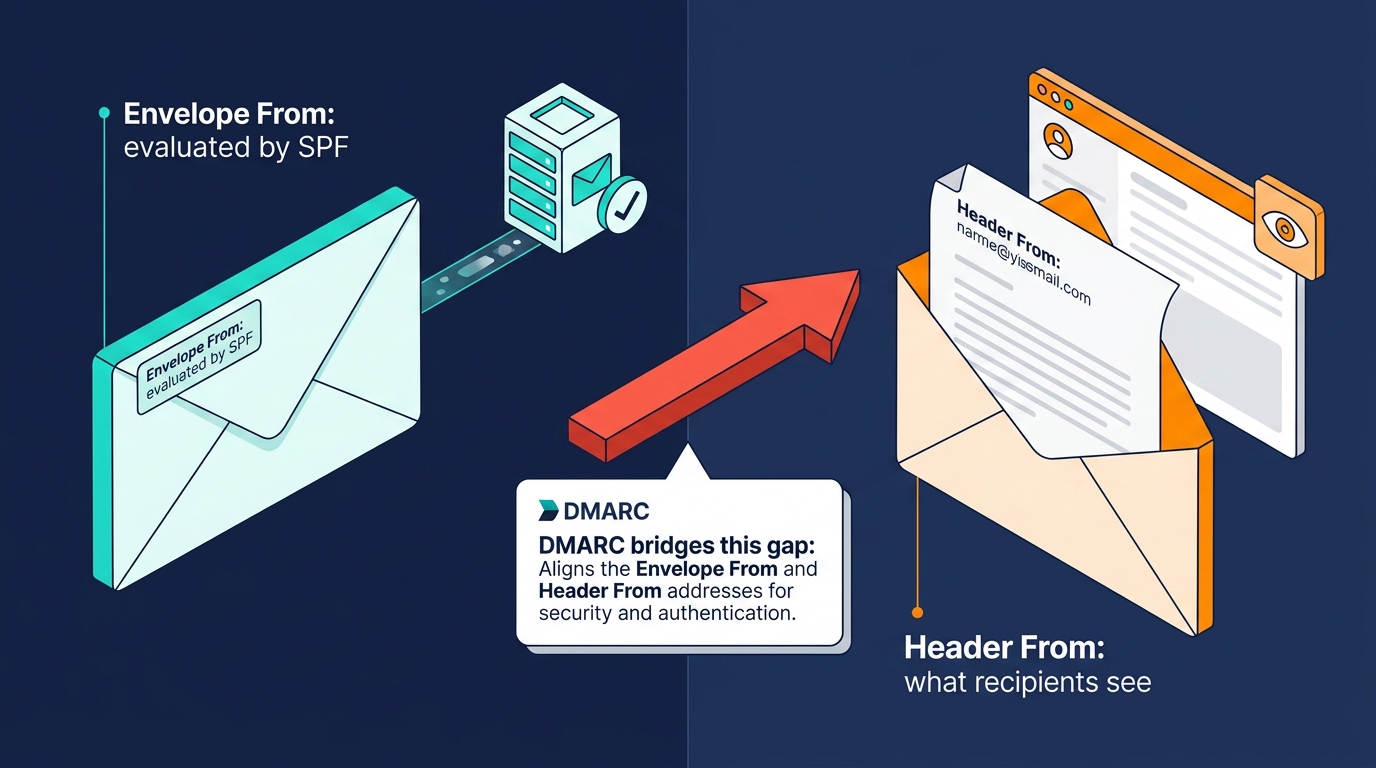
Every email carries two sender identities. The envelope From address is like the return address on the outside of a paper letter and supports the server-to-server transaction. The header From address appears inside the message and provides the identity most email applications display to the recipient. These values do not have to match, and SPF evaluates the envelope identity rather than the visible header address. The Authentication-Results header records SPF beside the envelope domain it evaluated. A tester can therefore distinguish that identity from the visible From domain.
An attacker can use a domain they control in the envelope, pass SPF for that domain, and place another organization's domain in the header From. DMARC addresses that gap by comparing an authenticated identity with the header From domain. When neither SPF nor DKIM passes with an aligned domain, DMARC allows the domain owner to request that receivers quarantine or reject the exact-domain forgery.
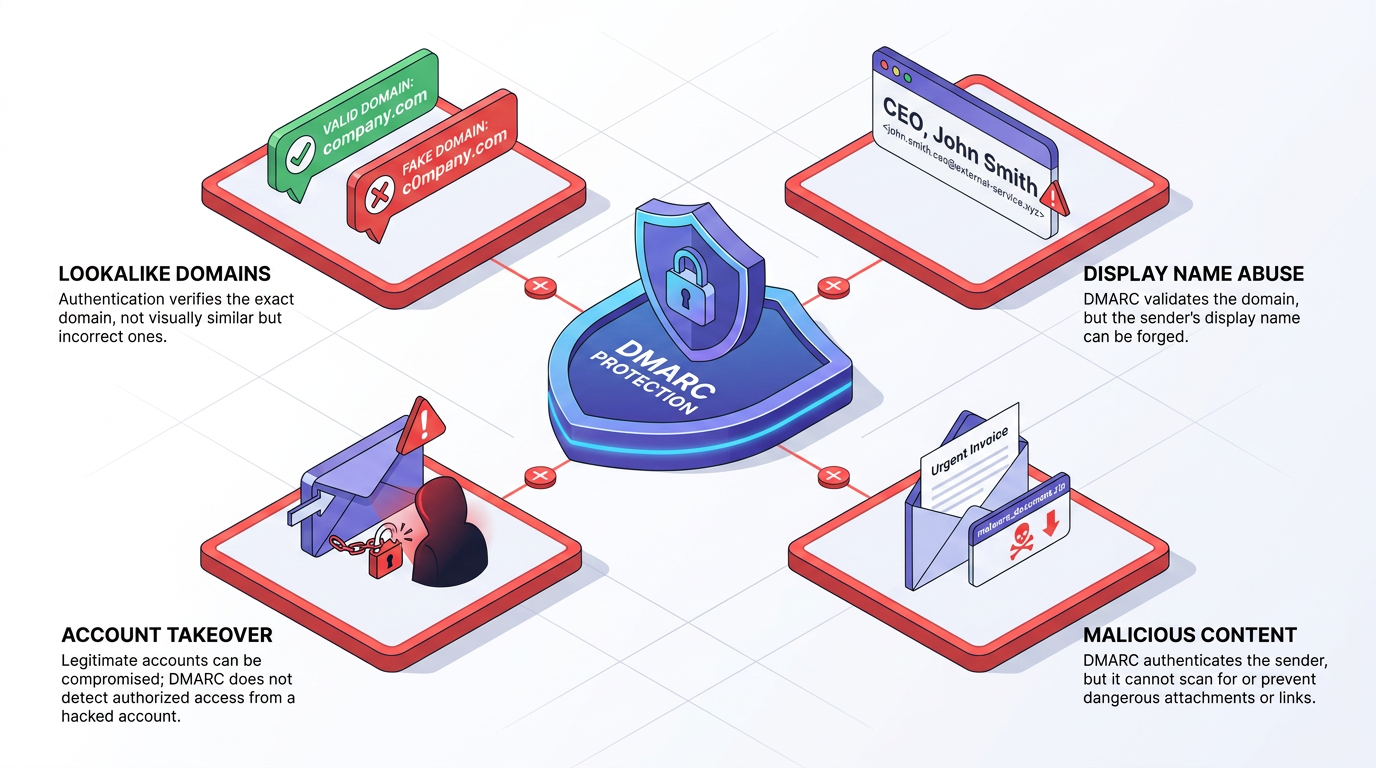
Other impersonation tactics cross that boundary. Display name spoofing pairs a trusted name with an unrelated address, while lookalike domains use attacker-owned names with altered words or visually similar characters. Because attackers control those domains, the messages may authenticate successfully under their own records. Mail from a compromised authorized account can also pass SPF, DKIM, and DMARC even when the message itself is malicious. These tactics require defenses beyond domain authentication.
How SPF, DKIM, and DMARC Close the Spoofing Gap
SPF and DKIM authenticate different parts of a message's origin, while DMARC connects those results to the visible From domain and supplies an enforcement request.
SPF as an Allowlist for the Envelope Sender
An SPF record is a DNS text entry that lists the systems authorized to send mail for a domain. When a message arrives, the receiving server looks up the record for the envelope From domain and checks whether it authorizes the connecting internet address. The result describes the connection and envelope identity, not necessarily the sender shown to the recipient.
This limitation means a passing SPF result says nothing about the visible address when the envelope and header domains differ. An attacker can authenticate an envelope domain they own while presenting another domain in the message header, so SPF alone cannot establish that the visible sender is genuine.
Forwarding creates another weakness because a forwarding system sends the message onward from a new address that may not appear in the original sender's SPF record. Records can also become unreliable when they authorize every sender or omit legitimate services. Too many nested DNS lookups can also make them unreliable. SPF therefore works best when the sender list is accurate and the authenticated envelope domain aligns with the domain recipients see.
DKIM as a Signature for the Message
DKIM authenticates the message rather than the network connection. The sending system signs selected headers and content with a private key, while the sender publishes the matching public key in DNS at a location identified by a selector. A receiving server retrieves that key and checks the signature. The result confirms which domain signed the message and whether the signed material remained unchanged.
Because the signature travels with the email, DKIM can survive simple forwarding when the intermediary leaves the signed content intact. It may fail when a forwarding service, mailing list, or other intermediary modifies a signed subject line, message body, or header.
DKIM does not provide an enforcement policy by itself, and a missing or failed signature does not independently tell a receiver whether to deliver, quarantine, or reject the message. A valid signature also proves only that the signing domain took responsibility for the message, not that it matches the visible sender. The signature becomes most useful when its domain aligns with the header From domain. An aligned signature gives DMARC an authenticated identity it can connect to the address the recipient sees.
DMARC as Alignment and Enforcement
DMARC operates on the header From domain and requires at least one underlying authentication result to pass and align with it. SPF alignment means the authenticated envelope domain matches the visible domain, while DKIM alignment means the signing domain matches it. Alignment may be exact or may occur at the broader organizational-domain level based on the configured mode.
Only one aligned pass is required. A forwarded message can fail SPF because the connecting server changed but still pass DMARC through a valid, aligned DKIM signature. SPF and DKIM can both pass while DMARC fails if each authenticates a third party's domain rather than the domain displayed to the recipient.
Alignment prevents an SPF pass for an attacker-controlled domain from supporting a forged header From address. The DMARC policy then tells the receiver how the domain owner wants the failure handled. A p=reject policy substantially reduces exact-domain forgery at receivers that evaluate and honor DMARC, although receiving systems may still apply local rules.
How to Run an Email Spoofing Test on Your Domain
A practical email spoofing test starts with DNS inspection and authorized message testing. Header review and a controlled move toward enforcement follow.
Checking DNS and Authorized Mail
A DNS lookup should first confirm whether the domain publishes SPF and DMARC records, then check each record for the following:
SPF Sender List and Qualifier: Identifies every legitimate sending service and ends with a qualifier describing how receivers should treat unauthorized systems
DMARC Policy Value: States the enforcement action requested for authentication failures
Aggregate Reporting Address: Allows participating receivers to send feedback on authentication results back to the domain owner
Subdomain Policy and Alignment Strictness: Separate settings that can be configured differently from the top-level domain
Percentage-Based Enforcement: Controls what portion of failing mail the policy applies to, useful for a gradual rollout
A record missing any of these elements is incomplete, even if it publishes without a DNS error.
DKIM public keys live under selector-specific DNS names, so the tester must know the selector before performing a direct lookup. A received message provides a practical alternative because its DKIM signature identifies both the signing domain and selector. The signing domain should align with the visible From domain when DKIM supports DMARC.
A normal message sent from the domain to a mailbox the tester controls can validate whether authorized mail passes and aligns in a real delivery flow. It does not directly prove how receivers will treat forged mail because the message came from legitimate infrastructure. Direct failure-handling assessment requires a controlled forged-message test against infrastructure the tester owns or has explicit written authorization to evaluate; without that authorization, DNS review and legitimate-message testing provide the appropriate posture assessment.
Reading Authentication Verdicts
Receiving systems record their decisions in the Authentication-Results header. Each check is recorded beside the domain it evaluated, and reading each verdict with its associated domain forms the core of the test:
Check | Domain It Evaluates
|
|---|---|
SPF | Envelope domain |
DKIM | Signing domain |
DMARC | Visible From domain |
Individual passes can still produce a DMARC failure. For example, a third-party sender may pass SPF using its own bounce domain and pass DKIM using its own signing domain while placing the customer's domain in the header From. Neither authenticated identity aligns with the visible domain, so DMARC fails even though both underlying checks passed.
That pattern commonly indicates that an organization never configured a legitimate sending service to use an aligned envelope domain or sign with the organization's domain. A DMARC pass on an authorized test message confirms that at least one authentication path passed and aligned end to end. A complete review considers both the verdict and its attached identities because a pass label without domain alignment can create false confidence.
Moving Policy Toward Enforcement
Deployment usually follows a set sequence:
Establish accurate SPF and DKIM records with aligned legitimate identifiers.
Add DMARC at p=none with an aggregate reporting address, so reports reveal which systems send using the domain, how they authenticate, and what actions participating receivers take.
Investigate unknown sending addresses and repeated alignment failures before increasing enforcement.
Move the policy from none to quarantine, then to reject, once legitimate sources consistently authenticate.
Quarantine is a useful intermediate step, but recipients may still retrieve and act on suspicious mail that receivers place in junk folders. Percentage-based enforcement can support a gradual rollout by applying the stronger policy to part of the failing mail stream.
Transitional settings should remain only as long as needed to correct legitimate senders. Moving too quickly can disrupt marketing platforms, customer support systems, ticketing tools, and other approved services that send under the domain, while remaining indefinitely at p=none continues to request monitoring rather than rejection. Ongoing aggregate-report review also matters because infrastructure, providers, signing keys, and delegated services can change over time.
What an Email Spoofing Test Can't Tell You
A passing test demonstrates that authorized mail aligns correctly and that the domain requests a particular response to failures, but it does not cover every form of impersonation.
Threats Beyond Exact-Domain Forgery
Lookalike domains fall outside DMARC because the attacker registers and controls the domain used to send the message. The legitimate organization's policy has no authority over a separate domain, even if its name closely resembles the real one.
Display name abuse creates a similar limitation. DMARC evaluates the domain in the address, not the friendly name displayed beside it, so an attacker can pair a trusted executive's name with an unrelated address. Account takeover also bypasses the distinction between legitimate and forged mail because messages from a compromised mailbox can authenticate through authorized systems.
These boundaries separate authentication from broader judgments about identity and content:
Exact-Domain Spoofing: A p=reject policy substantially reduces forgery of the real domain at receivers that honor DMARC.
Display Name Abuse: Authentication does not validate the friendly name shown beside an address.
Lookalike and Cousin Domains: A policy cannot govern attacker-owned domains that resemble the legitimate one.
Account Takeover: Mail from a compromised legitimate account can authenticate successfully.
Malicious Content: Authentication does not determine whether message text, attachments, or links are harmful.
Recognizing these limits matters because a domain owner who treats DMARC as complete protection may overlook the impersonation tactics attackers most often use once exact-domain forgery is blocked. Closing the remaining gaps requires layered defenses such as user training, content inspection, and behavioral analysis alongside authentication.
Misconfigurations That Weaken Enforcement
Several configurations appear protective while providing little practical enforcement:
DMARC Monitoring Without Reporting: A policy of p=none requests reporting but does not ask receivers to quarantine or reject failures, and without an aggregate reporting address, the domain owner loses the feedback needed to identify legitimate senders, alignment problems, and suspicious activity.
Overly Permissive or Complex SPF Records: A record that authorizes every internet address defeats the purpose of maintaining a sender allowlist, while an overly complex record can exceed the protocol's lookup limit and produce a permanent error; missing third-party senders can also cause legitimate mail to fail.
Inherited or Weak Subdomain Policies: Subdomains may inherit the parent domain's policy or publish their own, and a weaker subdomain policy can reopen a path for mail claiming to come from that part of the namespace.
Parked and non-sending domains need protection as well because attackers can spoof them even though the owner never sends legitimate mail.
For a non-sending domain, the appropriate outbound posture authorizes no senders, requests rejection through DMARC, and provides a reporting address. If the domain never receives mail, its mail configuration can also refuse inbound messages. These settings make the domain's intended mail activity explicit to receiving systems.
Turning a Test Into a Locked Door
A spoofing test turns an invisible risk into a practical review of authentication alignment and enforcement. Strong protection depends on accurate sender records, aligned legitimate mail, aggregate-report monitoring, and a policy that progresses to rejection. Impersonation remains possible. A spoofing test measures the reduction in exact-domain forgery and identifies changes that could weaken protection later.
Frequently Asked Questions
How Often Should You Run an Email Spoofing Test?
Retesting is useful whenever sending infrastructure changes. The addition of a marketing or customer management system is one such change. Adding a ticketing system also warrants a retest. Aggregate reports also need continuous review because sender addresses, delegated services, and signing keys can change over time.
Can an Email Pass SPF and DKIM but Still Fail DMARC?
Yes. DMARC fails when neither authenticated domain aligns with the visible From domain, even if SPF and DKIM independently pass. The sending service must use an aligned envelope domain or apply an aligned DKIM signature.
Do Domains That Never Send Email Need Authentication Records?
Yes. Attackers can still forge a non-sending domain if receiving systems have no policy to consult. Records that authorize no senders and request rejection make the domain's intended posture clear.
Is Email Spoofing the Same as Phishing?
No. Spoofing forges sender identity, while phishing tries to persuade a recipient to reveal information or take a harmful action. Phishing can also use lookalike domains, misleading display names, or compromised legitimate accounts.