Key Insights
Manufacturing has held the top spot as the most targeted industry for cyberattacks for five consecutive years, accounting for 27.7% of all cybersecurity incidents in 2025.
Every one of those incidents starts the same way: an email that looks routine enough to open. Extortion accounts for a significant share of reported incidents, while data theft targets high-value intellectual property, with email as the primary delivery mechanism for both. Even as some attack vectors shift, manufacturing continues to see the highest number of ransomware cases driven by attackers exploiting outdated legacy systems and unpatched vulnerabilities that remain common across the sector.
Stopping these attacks means adopting AI email security built to catch sophistication that traditional tools miss. Manufacturers don't need to choose between production uptime and email security — the right AI-driven approach protects both.
Key Takeaways
- Manufacturing has ranked as the most targeted industry for cyberattacks for five straight years, with email as the primary delivery mechanism for both extortion and intellectual property theft.
- Traditional secure email gateways evaluate messages in isolation and often miss socially engineered attacks like fraudulent bank-detail changes or fake invoice requests.
- Generative AI has cut the time needed to craft a convincing phishing email from 16 hours to 5 minutes, according to IBM research, while AI-automated phishing emails reach a 54% click-through rate compared with 12% for generic attempts.
- Behavioral AI builds communication baselines for employees, vendors, and customers, which helps flag anomalous payment requests, look-alike domains, and compromised vendor accounts that pass standard authentication checks.
- At Avery Dennison, Abnormal detected and prevented 358 BEC attacks and identified 330 high-risk vendors within 90 days of deployment.
Why Email Security Matters in Manufacturing
Manufacturing requires AI-powered email security because operations face unique vulnerabilities that make email security failures particularly catastrophic. Production environments depend on continuous uptime, just-in-time delivery schedules, and complex supply chain coordination, all of which become targets when email defenses fail.
Operational contagion amplifies attack impact significantly. Attackers weaponize compromised mailboxes to target downstream suppliers and customers, using trusted business relationships to spread malware and harvest additional credentials. The inbox has become a high-speed distribution hub for threats that ripple across entire manufacturing networks.
IT and operational technology systems in manufacturing are closely connected, creating new risks for cyberattacks. Many plants run old controllers alongside cloud-connected devices, leaving security vulnerabilities. If phishing emails compromise office computers, attackers can move into production networks that are difficult to patch or shut down without disrupting operations.
What Makes Manufacturing a Target
Manufacturing organizations present concentrated attack opportunities that cybercriminals actively exploit through sophisticated email campaigns. The combination of valuable intellectual property, complex operational infrastructure, and extensive partner networks creates optimal conditions for successful attacks.
High-Value Intellectual Property and Trade Secrets
Manufacturing companies hold valuable designs, processes, and innovations built over decades. Sensitive files such as CAD drawings and automation programs often move through email, making them prime targets. Once stolen, this intellectual property allows competitors to copy products without R&D, causing long-term damage to market position and innovation potential.
Complex Supply Chain Vulnerabilities
Manufacturing relies on vast networks of suppliers, logistics partners, and contractors, with frequent email exchanges for invoices, shipments, and banking changes. Cybercriminals exploit these trusted channels using look-alike domains or compromised vendor accounts to bypass security. The FBI has specifically warned that business email compromise scams "primarily target businesses that work with foreign suppliers or regularly perform wire transfer payments," a profile that fits the vast majority of manufacturing organizations. In 2025, BEC losses reported to the FBI IC3 reached $3.047 billion, underscoring the financial severity of these attacks.
One breached mailbox can spread fraudulent messages across facilities, endangering customers and partners. The high volume of legitimate communications makes spotting sophisticated impersonation attempts challenging for employees.
Operational Pressure and Human Factors
Frontline operators and production schedulers often work rotating shifts, share terminals, and receive less cybersecurity training than office staff, making them vulnerable to AI-driven social engineering. Tight production deadlines, strict quality standards, and delivery pressures reduce scrutiny of urgent email requests.
Phishing-based infostealer attacks are accelerating at an alarming rate. IBM X-Force reported an 84% increase in emails delivering infostealers in 2024 compared to the prior year, giving criminals fresh credentials to hijack ongoing conversations and remain hidden within legitimate business communications for extended periods.
Why Traditional Defenses Fall Short
Traditional email security tools often struggle to stop the sophisticated, context-aware threats that target manufacturing operations. Many rely on older technology built for a simpler threat environment, which means they are not equipped to detect attacks that exploit the industry's unique workflows and vendor relationships.
Static detection methods are a significant limitation. Legacy secure email gateways typically examine each message in isolation, focusing on known malware or obvious red flags. While this approach can block some threats, it frequently misses the subtle, socially engineered attacks that are now common. Fraudulent bank detail changes, fake invoice requests, or AI-generated messages crafted to look entirely legitimate can pass through unnoticed. The challenge has deepened as generative AI tools have reduced the time needed to craft a convincing phishing email from 16 hours to 5 minutes, according to IBM research.
Without the ability to understand the context of communication, such as who normally sends payment requests or when certain vendors reach out, these tools leave manufacturers exposed to attacks designed to fit into everyday business operations.
7 Ways to Use AI Email Security to Protect Your Manufacturing Business
AI-powered email security tackles the critical vulnerabilities that traditional filters often overlook in manufacturing. These advanced systems recognize the unique operational context, supply chain connections, and production workflows that define the industry, adapting in real time to stay ahead of evolving threats.
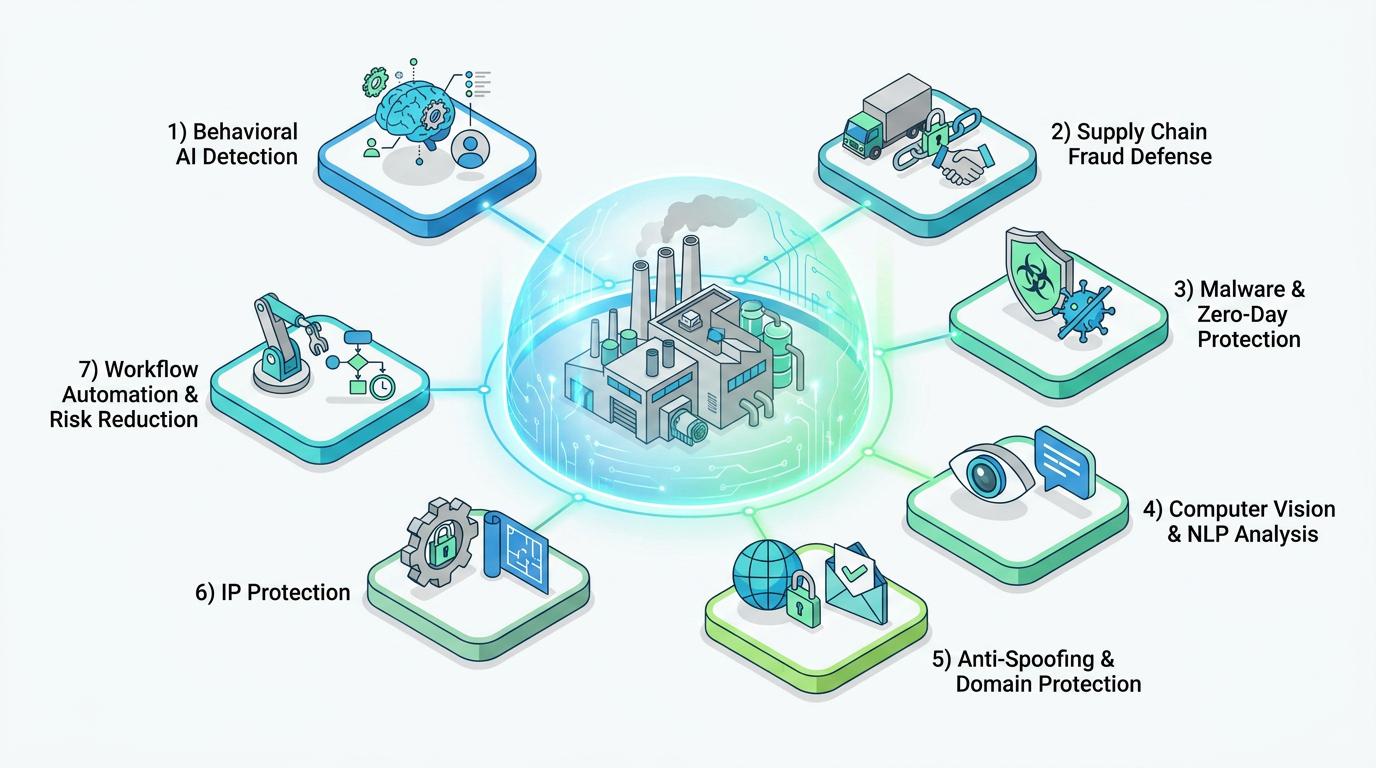
Here are seven ways AI can help safeguard manufacturing businesses:
1. Implement Behavioral AI Detection for Advanced Phishing and BEC
Behavioral AI establishes complete communication baselines for every user and vendor relationship, detecting anomalous payment requests that pass standard SPF, DKIM, and DMARC authentication. The system learns normal interaction patterns among plant managers, procurement teams, and production schedulers while accounting for seasonal shutdowns, shift transitions, and production ramp-ups.
When spoofed executives request urgent wire transfers with unusual timing or tone, AI compares messages against months of historical communication data and automatically blocks the suspicious requests. Integration with ERP and MRP systems also supports real-time validation of purchase order numbers, invoice patterns, and vendor relationship authenticity.
2. Deploy AI-Enhanced Supply Chain and Vendor Fraud Defense
Supply chain communications generate continuous email traffic containing invoices, shipping notifications, and change orders that attackers systematically target for financial fraud. AI models trained on supplier communication patterns automatically flag anomalous banking details, altered payment terms, or fraudulent tracking links from look-alike domains before they reach finance teams.
Real-time integration with accounts payable systems validates routing numbers and purchase order references, preventing fraudulent payments that could disrupt supplier relationships. The system builds vendor-specific baselines for invoice formats, currencies, and delivery schedules.
3. Use AI-Powered Malware and Zero-Day Protection
Machine learning pipelines analyze every attachment and embedded link before message delivery, examining entropy patterns, embedded macros, and callback behaviors that signature-based scanners consistently miss. Manufacturing-specific sandboxing environments safely detonate CAD files, PLC configurations, and firmware images to reveal hidden payloads without disrupting engineering workflows.
Systems check plant maintenance schedules and apply extra scrutiny to emails claiming to include "critical firmware patches" outside planned maintenance windows. This helps block ransomware, which remains the leading cause of manufacturing downtime. According to the Dragos 2026 OT/ICS Year in Review, manufacturing accounted for more than two-thirds of all ransomware victims across industrial organizations in 2025, with ransomware groups targeting the sector surging 49% year-over-year, from 80 groups to 119.
4. Use Computer Vision and NLP Content Analysis
Computer vision algorithms compare visual elements against verified templates from OEMs and logistics partners, detecting pixel-perfect logo replications, fraudulent QR codes, and cloned layouts that deceive human perception. Natural language processing simultaneously analyzes message intent, identifying high-risk requests to approve shipments, release purchase orders, or override quality control holds.
This capability is increasingly critical as AI-assisted attacks eliminate the traditional grammatical errors that once served as warning signs. The Verizon 2025 Data Breach Investigations Report found that synthetically generated text in malicious emails has doubled over the past two years, while research shows AI-automated phishing emails achieve a 54% click-through rate, compared with just 12% for generic phishing messages.
Verified templates for advance shipping notices and quality reports maintain operational flow while deviations trigger automated verification workflows, addressing the surge in AI-enhanced phishing kits targeting experienced manufacturing personnel.
5. Deploy Adaptive Anti-Spoofing and Domain Protection
AI continuously evaluates sender infrastructure, TLS certificates, and domain registration data to identify look-alike domains registered specifically for impersonation attacks. Systems maintain stricter anomaly detection thresholds for high-risk manufacturing roles, including CFOs, procurement managers, and plant operations directors.
Automated monitoring detects subtle domain misspellings and homograph attacks targeting established supplier relationships while allowing legitimate supplier onboarding processes and emergency communications.
6. Implement AI-Guided Intellectual Property Protection
AI classifiers automatically recognize sensitive intellectual property, including CAD drawings, bills of materials, and process parameters, applying encryption or quarantine policies when content leaves organizational boundaries. Systems identify manufacturing-specific artifacts such as title blocks, part numbers, and firmware references to prevent accidental data exfiltration.
Partner-specific secure channels support trusted design collaboration while blocking unauthorized requests for 3D models or technical specifications, maintaining productivity while meeting relevant regulatory and trade secret protection requirements.
7. Use AI-Driven Risk Reduction and Workflow Automation
Intelligent coaching systems deliver contextual security guidance when users encounter suspicious vendor banking changes or urgent approval requests, explaining specific risk indicators in clear, actionable language. Automated incident response systems route high-risk messages to security teams with complete context while simultaneously removing similar threats from other user mailboxes.
Adaptive allowlisting reduces alert fatigue by learning legitimate business processes, such as recurring quality reports from external testing laboratories or seasonal communications from key suppliers.
How Abnormal Supports Manufacturing Teams
Manufacturing organizations require cybersecurity that balances production efficiency with protection against supply chain fraud and intellectual property theft. Abnormal's behavioral AI establishes communication baselines for users and vendors, helping detect anomalies that signal account compromise or vendor impersonation before they impact operations.
The platform analyzes identity, behavioral, and content signals to identify irregularities in ongoing communications, helping prevent business email compromise and vendor fraud. Additionally, Abnormal's API-based integration with platforms supports rapid deployment without operational disruption.
Avery Dennison, a Fortune 500 materials science leader with 36,000+ employees across 50+ countries, faced sophisticated email threats bypassing their existing Google Workspace security. Their six-person security team struggled to prevent advanced attacks while protecting thousands of vendor relationships and maintaining 100% production uptime.
After deploying Abnormal's behavioral AI platform, the company immediately improved threat detection and automated manual investigation processes. Within 90 days, Abnormal detected and prevented 358 BEC attacks, identified 330 high-risk vendors requiring verification, and saved the security team 40 hours weekly.
The platform excelled at detecting compromised vendor accounts and preventing fraudulent payments, including stopping a fake $200,000 invoice that protected both Avery Dennison and its vendor relationship.
Want to see how Abnormal can secure your manufacturing operations? Explore our customer stories and request a demo to see manufacturing-tailored tools in action.